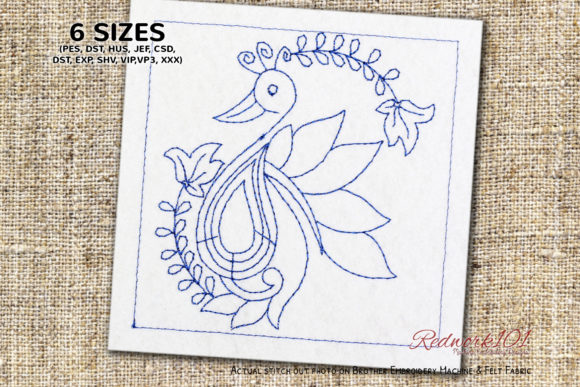
Peacock Floral Pattern Redwork
A Designer’s Real-World Review for Small Business Merchandise
As an embroidery designer who’s developed hundreds of commercial embroidery files for cafés, boutiques, florists, pet brands, and handmade studios, I approach every new design with two questions: Will it translate professionally across diverse products? and Does it strengthen—rather than dilute—brand identity? That’s why Peacock Floral Pattern Redwork caught my attention. At first glance, the name evokes elegance and artisanal charm—peacocks suggest sophistication; florals imply warmth and organic appeal; “redwork” signals classic, hand-stitched authenticity. For small business owners seeking embroidered patches, staff aprons, tote bag accents, or cap embroidery, this isn’t just decorative—it’s a brand voice stitched in thread.
First Impression: Handmade Elegance Meets Commercial Readiness
Peacock Floral Pattern Redwork lands as elegant yet approachable—a rare balance. It avoids being overly ornate (which can overwhelm small patch sizes) or too minimal (which risks looking generic on custom apparel). The redwork style implies tradition and craftsmanship, making it ideal for businesses that emphasize authenticity: a neighborhood bakery, a botanical-themed boutique, or a sustainable pet brand. Unlike mass-produced clipart, this design feels intentional—like it belongs on a linen apron at a flower shop or stitched onto the chest of a barista’s uniform. Its placement in the Intricate Cuts category hints at thoughtful line work and clean edges—critical for crisp embroidered patches and consistent reproduction across fabric types.
How It Performs Across Key Small Business Applications
- Embroidered patches: Works beautifully at 2.5"–3.5" height—maintains legibility and flow without excessive stitch density. Ideal for sew-on or iron-on application on jackets, tote bags, or product packaging.
- Staff uniforms & aprons: Scales well to chest placement (left or right) on cotton twill or denim. The floral-peacock motif reads clearly from 6+ feet away, reinforcing brand recognition without shouting.
- Cap embroidery: Best suited for structured front panels (not curved back sections) where detail retention is highest. Avoid using below 2" width—fine stems and feather contours may blur.
- Tote bag design & boutique merchandise: Shines as a centered focal point on natural canvas or unbleached cotton. Complements minimalist branding while adding visual texture and story.
- Product labels & customer gifts: Translates elegantly onto woven labels, tea towels, or ceramic coaster sleeves—especially when paired with complementary thread colors like burgundy, charcoal, or oatmeal.
Where to Use Peacock Floral Pattern Redwork Thoughtfully
This design excels—but isn’t universally bulletproof. As a professional embroiderer, I recommend caution in these scenarios:
- Small patch sizes under 2": Delicate feather tips and narrow floral stems may lose definition. Always test at intended size before bulk production.
- Dark or textured fabrics: Redwork traditionally relies on contrast. On black uniforms or nubby burlap, confirm thread color visibility—consider navy or deep wine instead of classic red.
- Frequent-wash items (e.g., restaurant aprons): Verify stitch density isn’t so high it compromises durability. Overly dense fills can stiffen fabric and crack over time.
- Curved surfaces (like cap backs or sleeve cuffs): Avoid placing intricate sections along tight curves—opt for simplified versions or alternate placements.
- Commercial embroidery projects requiring scalability: Confirm the digital embroidery file includes multiple sizes—or be prepared to resize carefully (never stretch disproportionately).
Impact on Brand Identity & Customer Perception
Peacock Floral Pattern Redwork does more than decorate—it communicates. When stitched onto a café’s linen apron or a florist’s reusable tote, it signals care, artistry, and intentionality. Customers subconsciously associate that level of detail with quality—and trust follows. For Etsy sellers and handmade brands, it reinforces the handmade product narrative without looking amateurish. For local businesses, it adds memorability: imagine a peacock feather subtly echoing your logo’s curve, or floral vines wrapping around your shop name on a custom tag. That kind of visual consistency builds recognition faster than text alone. And because it’s rooted in redwork—a technique tied to heritage and patience—it elevates perceived product value, especially in premium or gift-oriented markets.
Practical Designer Notes Before You Stitch
Before sending Peacock Floral Pattern Redwork to production, here’s what I always do:
- Test it in black and white first—eliminates color bias and reveals true line clarity and spacing.
- Check performance at your smallest intended patch size (e.g., 1.75")—zoom in on feather ends and petal edges.
- Review thread color contrast on your target fabric—swatch real thread on real material, not just screen previews.
- Inspect spacing between elements—tight gaps may merge during stitching, especially on low-tension machines.
- Confirm hoop size compatibility—some intricate cuts require larger hoops or re-hooping mid-stitch.
- Test on actual fabric—not just stabilizer—using your intended needle, thread, and machine settings.
- Create a printable mockup for client approval—show it on a realistic garment or bag template.
- Compare it beside your other design assets—does it harmonize with your logo, typography, and brand palette?
- Verify commercial licensing—since this is for small business merch and branded patch use, ensure your digital embroidery file permits resale, distribution, and embroidered product sales.
Remember: the “Stitch Box shown in the picture is optional” note signals flexibility—but also means presentation depends entirely on your execution. The outer box color variation mentioned (“a different color in most o”) reminds us that final output hinges on your choices: thread selection, fabric base, stabilizer type, and finishing method. That’s where your expertise as a small business owner or embroidery shop makes all the difference.
Used intentionally, Peacock Floral Pattern Redwork isn’t just another machine embroidery design—it’s a quiet ambassador for your brand. It says you value beauty *and* function, tradition *and* relevance, detail *and* wearability. Whether stitched on a baker’s cap or a pet brand’s bandana, it turns everyday items into touchpoints of trust. And in today’s crowded marketplace, that kind of resonance? That’s worth every stitch.