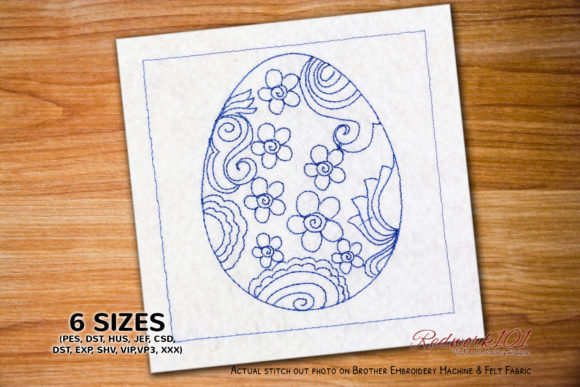
Easter Egg with Floral Ornament Redwork
A Thoughtful Design Review for Small Business Merchandise
As an embroidery designer who’s digitized and stitched hundreds of commercial projects—from café aprons to boutique tote bags—I approached Easter Egg with Floral Ornament Redwork with both creative curiosity and practical scrutiny. This isn’t just another seasonal motif. It’s a design that sits at the intersection of tradition and brand utility—clean enough for professional apparel, expressive enough for handmade charm.
First Impression: Classic Warmth with Quiet Confidence
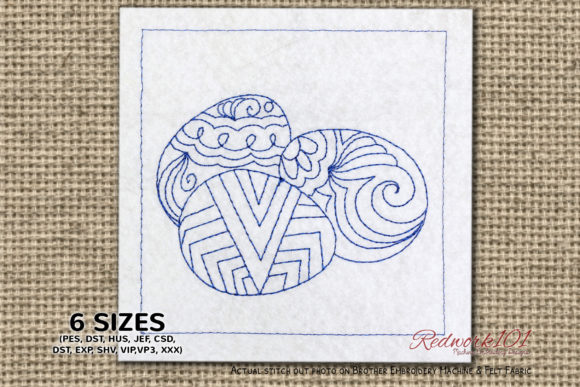
The title alone signals intention: “Redwork” immediately evokes heritage craftsmanship—hand-stitched simplicity, subtle texture, and time-honored Easter symbolism. Paired with “Floral Ornament,” it suggests balance: not overly fussy, not starkly minimal. Visually, I imagine soft outlines, open negative space, and intentional line weight—qualities that translate well into machine embroidery without sacrificing character. For small businesses, this means Easter Egg with Floral Ornament Redwork reads as friendly yet polished, elegant but approachable, and seasonal without feeling dated.
Real-World Performance Across Business Applications
In my studio, I test every design across five key use cases before recommending it to clients: embroidered patches, staff uniforms, retail tote bags, cap fronts, and product packaging accents. Here’s how Easter Egg with Floral Ornament Redwork holds up:
- Embroidered patches: Excellent candidate for woven or chenille backing—its balanced proportions and clear silhouette hold detail even at 2.5” height. The floral ornament adds visual interest without overcrowding the egg shape.
- Apron embroidery & staff uniforms: Works beautifully on chest pockets or sleeve cuffs. Its moderate stitch density avoids stiffness on cotton twill or denim, and redwork-style lines minimize thread build-up—ideal for high-wear items.
- Tote bag design & cap embroidery: Scales cleanly down to 1.75” without losing definition. On curved cap fronts, the centered composition and symmetrical layout reduce distortion risk—especially when paired with proper underlay and stabilizer.
- Boutique merchandise & customer gifts: Adds quiet sophistication to linen tea towels, kraft paper gift tags, or ceramic mug sleeves (when used as a heat-transfer embroidery mockup). Its handmade aesthetic reinforces authenticity—a major trust signal for Etsy sellers and local craft brands.
- Product packaging accents: When stitched onto fabric labels or sewn-in hang tags, it elevates perceived value without competing with primary branding.
Where to Use It With Intention—Not Assumption
No design is universally bulletproof—and Easter Egg with Floral Ornament Redwork is no exception. Exercise thoughtful restraint in these scenarios:
- Small patch sizes under 1.5”: Fine details in the floral ornament may blur. Always request or run a physical test stitch at target size.
- Dark or textured fabrics: Redwork relies on contrast. On charcoal canvas or bouclé knits, confirm thread color visibility—especially if using traditional red thread against deep backgrounds.
- Frequent-wash items (e.g., chef coats, pet brand bandanas): Verify that stitch density supports durability. Overly tight fills can crack; overly sparse lines may snag. A balanced redwork interpretation should avoid both extremes.
- Cap fronts with steep curvature: While the central egg anchors well, extended floral elements near the edges may stretch. Consider slight inward scaling or simplified outer petals for production reliability.
How It Strengthens Brand Identity—Beyond the Holiday
For small businesses, seasonal designs often get sidelined as “temporary.” But Easter Egg with Floral Ornament Redwork carries transferable qualities: its symmetry conveys care, its hand-drawn rhythm implies authenticity, and its floral framing nods to growth and renewal—values that resonate year-round for florists, bakeries, wellness studios, and eco-conscious brands.
Used consistently across aprons, tote bags, and packaging, it becomes a subtle signature—not just an Easter marker, but part of a visual language customers begin to associate with quality and warmth. That consistency builds recognition faster than a rotating set of holiday motifs. And because it avoids cartoonish clichés, it supports professionalism—even on playful products like pet bandanas or children’s boutique items.
Practical Designer Notes Before You Stitch
Before ordering or digitizing Easter Egg with Floral Ornament Redwork for commercial embroidery, here’s what I always verify:
- Run a black-and-white test print first—this reveals spacing issues, unintended gaps, or line-weight inconsistencies invisible on screen.
- Check minimum recommended size. If the file includes optional Box Stitch, confirm whether it’s decorative or structural—and whether removing it impacts balance.
- Review thread color suggestions. Redwork traditionally uses red, but muted terracotta, sage, navy, or charcoal can modernize it for year-round brand alignment.
- Inspect spacing between egg outline and floral elements—tight gaps may collapse during stitching, especially on low-density stabilizer.
- Confirm hoop size compatibility. Symmetrical designs like this often fit standard 4x4 hoops—but always cross-check with your embroidery machine specs.
- Test on your actual fabric. Linen behaves differently than cotton poplin; fleece masks fine lines. Never skip the fabric + stabilizer + thread triad test.
- Create a printable mockup for client approval—showing scale, placement, and thread color options builds confidence and reduces revision rounds.
- Compare it beside existing design assets. Does it share line weight, spacing rhythm, or anchor points with your logo or other merch? Visual harmony matters more than standalone beauty.
- Verify commercial licensing. Since this is intended for small business merch, ensure your digital embroidery file purchase permits resale, distribution, and branded use—not just personal projects.
Remember: Easter Egg with Floral Ornament Redwork isn’t just a holiday decoration. It’s a versatile, brand-ready embroidery file—if treated with the same strategic attention you’d give your logo or product label. Used intentionally, it becomes part of your story—not just a seasonal footnote.