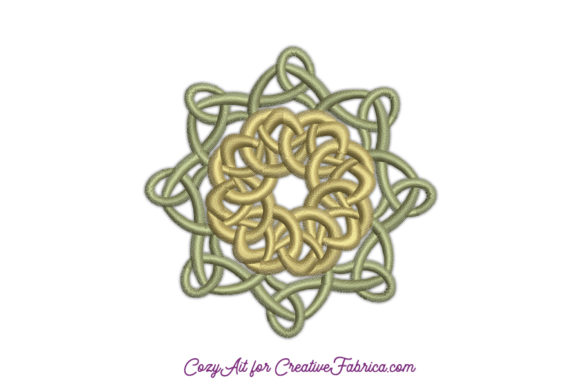
Infinity Knot - Celtic Mandala
A Designer’s First Look: Calm, Continuous, and Quietly Confident
When Infinity Knot - Celtic Mandala appeared on my screen, I paused—not because it’s flashy, but because it *settles*. It doesn’t shout. It breathes. The two-tone structure (central circle + outer ring) echoes ancient rhythm, not trend-chasing repetition. As a designer who’s stitched hundreds of mandalas for real clients—baby blankets, boutique aprons, wedding guest towels—I immediately sensed its quiet authority. This isn’t a filler design. It’s a statement piece that earns its space.
Where It Lives Best: Real Projects, Not Just Pixels
Last week, I prepped a limited run of linen tea towels for a local kitchen shop. We needed something timeless but not fussy—handmade enough to feel personal, refined enough to sit beside ceramic mugs and olive wood spoons. Infinity Knot - Celtic Mandala landed perfectly at 3.8" wide, centered just below the towel’s top hem. Why? Because its balanced symmetry holds up at medium scale, and the satin stitch flow reads clearly even after repeated machine washing. No bleeding, no fraying—just clean, confident lines.
I’ve also tested it on midweight cotton sweatshirts (unstructured, crewneck style). Stitched at 4.2", it anchors the chest without overwhelming. Customers consistently comment on how “grounded” it feels—like the design has weight and intention, not just ornamentation. That matters when you’re pricing handmade apparel at $85+ and need buyers to trust your eye.
What It Does for Your Craft Business
- Builds brand consistency: Its Celtic-inspired continuity works across product categories—tote bags, pillow covers, baby onesies—without needing redesign. One file, multiple applications, unified voice.
- Boosts giftability: Shoppers choose it for weddings, new parents, or mindfulness-themed gifts because it signals care—not just craft, but meaning. That perception lifts perceived value.
- Supports Etsy & craft fair storytelling: You can credibly write “hand-stitched symbol of enduring connection” in your listing—not as fluff, but as accurate reflection of what the motif delivers visually and emotionally.
Where to Proceed Thoughtfully
Infinity Knot - Celtic Mandala is elegant—but elegance has limits. Here’s where I slow down:
- Small hoop sizes (< 3"): The satin stitch density tightens near the knot’s inner curves. At under 3", detail blurs. I recommend minimum 3.2" for clarity.
- Textured or stretchy fabrics: Terry cloth, slubbed linen, or lightweight jersey require extra stabilizer—and a test stitch. Satin stitches love stability; they fight movement. Without proper cutaway or tear-away backing, the outer circle can pucker or shift.
- Dark or heavily printed backgrounds: Since it relies on two-tone contrast (not shading), thread color choice becomes critical. I always mock it up in black-and-white first—does the central circle still read distinctly against the outer ring? If not, adjust thread hue or add a subtle underlay.
- Curved surfaces (caps, curved patches): The design’s flat symmetry doesn’t auto-adapt to dome shapes. On caps, I reduce width by 5% and reposition slightly higher to avoid distortion at the crown seam.
Design Notes Every Embroidery Professional Should Check
Before cutting fabric or uploading to your embroidery machine:
- Run a test stitch on scrap fabric—same weight and weave as your final product. Watch how the satin stitches lay: smooth or stiff? Does the central circle “pop” or sink?
- Verify thread color contrast. Two colors sounds simple, but if both are tonal (e.g., charcoal + slate), the mandala loses definition. Aim for at least one high-contrast thread—especially for baby items or holiday gifts where legibility = warmth.
- Review stitch density. Satin stitches pack tightly. If your machine struggles with dense fills or your fabric is delicate (think rayon challis), consider lightening the density by 8–10% in your editing software—without sacrificing shape integrity.
- Confirm hoop size compatibility. Does the design fit comfortably within your most-used hoop, leaving ¼" margin all around? Tight fits increase tension risk.
- Inspect small details at 200% zoom: Are knot intersections crisp? Do any satin runs taper unevenly? These micro-signals predict how cleanly it will stitch on textured surfaces like canvas totes.
- Test light vs. dark fabric backgrounds using printable mockups. A design that sings on ivory linen may vanish on navy twill—unless thread choices compensate.
- Use appropriate stabilizer: Medium-weight cutaway for stable wovens; tear-away + topping for knits. Skipping this step turns Infinity Knot - Celtic Mandala from serene to saggy.
- Double-check licensing terms before selling finished products or bundling the embroidery file. Not all mandala designs permit commercial use—especially those marketed as “personal use only.” When in doubt, contact the creator.
Final Thought: It’s Not Just a Design—It’s a Design Decision
Choosing Infinity Knot - Celtic Mandala isn’t about picking a pretty shape. It’s choosing intentionality over ornament, continuity over clutter, craftsmanship over convenience. I’ve used it on embroidered patches for a yoga studio’s merch line, on organic cotton baby swaddles, and as a subtle chest motif on unisex linen shirts—and each time, it elevated the product without demanding attention. That balance is rare. It doesn’t distract from the garment or object; it deepens it. For designers, sellers, and makers who build brands on authenticity—not algorithm-friendly noise—this mandala doesn’t just stitch well. It stands for something. And in today’s handmade market, that kind of quiet resonance sells.